
Alba in Piedmont
Towers, Truffles & Travel Tips – My Personal Guide to Visiting Alba
For many, a visit to Alba is simply a must when traveling through Piedmont. And yes, the town definitely has its own charm: narrow alleys, white truffles, medieval towers, and a glass of Barolo in hand – sounds like the italian dream.
But to be honest? I think Alba is a bit overrated. The old town is undeniably beautiful (just like many others in Piedmont), but it’s often crowded with tourists, and the truffle hype spills into just about every shop window.
That said, I’ve been there multiple times because Alba isn’t just pretty, it’s also a fantastic base for exploring the surrounding wine region of the Langhe.
I’ll show you what’s actually worth seeing in Alba, which sights you shouldn’t miss and I am adding as well as some close-by must-see castles in the wine region.
History Walking Tour and Food Tasting with a Local
Discover the sights of Alba on an exclusive guided food tour with several food tastings like cheese, salami, truffle products, and more.
Things to See in Alba
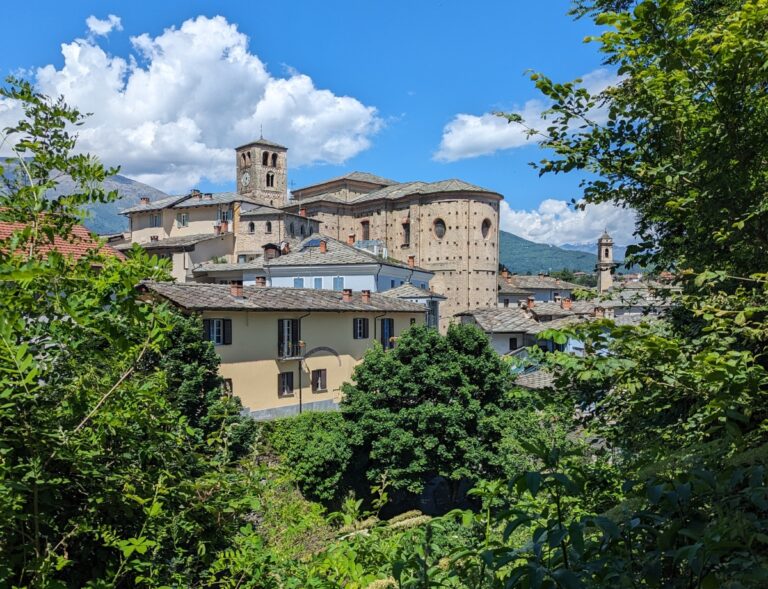
Alba may not be a large city, but its old town is packed with historic buildings, towers, and palazzi. Some are easy to miss, while others stand out immediately.
What I remember most from my visits is that subtle scent of chocolate that sometimes hangs in the air as you wander the streets.
When the wind is just right, a sweet chocolate aroma drifts into the town from the nearby Ferrero factory, which sits just outside the center. This is where classics like Ferrero Rocher, Nutella, and Kinder chocolate are made.
My tip: Plan to spend about half a day exploring Alba’s main sights. The town is very walkable and best enjoyed in combination with a Barolo wine tasting trip.


Cathedral of Alba (Cattedrale di San Lorenzo)
The cathedral stands right in the heart of the city, on Piazza Risorgimento, and is impossible to miss. It’s one of Alba’s most important landmarks and has a history dating back to Roman times.
The current structure dates mostly from the 12th century. Its most striking feature is the tall bell tower – one of the highest in all of Piedmont. Parts of the church floor have been opened up to reveal archaeological layers beneath, giving you a direct view into the past.
Best time to visit: early morning or late afternoon, when things are quieter. If you’re into architecture, take a closer look at the portals and the façade. You’ll still see clear traces of the original Romanesque design.

Piazza Risorgimento (also known as Piazza Duomo)
Piazza Risorgimento is the vibrant heart of Alba and one of the largest and most beautiful squares in the city.
It’s home not only to the cathedral but also to the Town Hall (Palazzo Comunale) and the Tourist Information Office. A great place to start your visit if you’re looking for orientation or want to find out about current events and exhibitions.
The town hall itself was built on the ruins of an ancient Roman structure. Inside, you’ll find a series of beautiful frescoes that originally came from the Church of San Domenico and are now open to the public.

Chiesa San Domenico
Just off the main pedestrian zone stands the Gothic brick church of San Domenico, with its wide, three-nave interior that never fails to impress.
What I find especially striking are the well-preserved 16th-century fresco fragments, which seem to glow against the clean lines of the red brick architecture.
Here’s a curious detail: During the Napoleonic occupation, the church was used as a stable for horses. Today, the bright and airy nave regularly hosts theatre performances and concerts, a unique setting for cultural events.
My tip: Just in front of the church there is a lovely small café, Caffè Teatro, which is an ideal spot to have a break and relax from sightseeing.

Chiesa di San Giovanni Battista
A bit quieter than the cathedral but no less important historically: San Giovanni Battista is considered one of the oldest churches in Alba, after the Cathedral of San Lorenzo and the now-lost church of Santa Maria del Ponte.
It’s located on Piazza Pertinace and doesn’t make much of a statement from the outside. But step inside, and you’ll be surprised by the beautifully crafted Baroque ceiling and artworks by renowned artists like Barnaba da Modena, Nicola da Tolentino, and Moncalvo.
If you’re even slightly interested in sacred art, this church is well worth a short visit; the serene atmosphere alone makes it a memorable stop.


Alba’s Old City Walls
Only fragments remain of Alba’s former city walls, but if you pay attention, you can still spot traces of them woven into the modern cityscape.
Originally, the walls stood over two meters high and about half a meter thick. Each of the town’s four gates was once guarded by one or two watchtowers.
The best-preserved towers can be found between Piazza Risorgimento and Via Cavour. Especially worth noting: the Torre di Casa Chiarlone on Via Calissano, one of the few towers still clearly visible, now elegantly integrated into the surrounding buildings.
My tip: Take a few minutes to stroll slowly and look for pieces of the old wall and tower foundations. The history of Alba is quite literally beneath your feet.
Alba’s Pedestrian Zone – Via Vittorio Emanuele
Via Vittorio Emanuele is the lively pedestrian street that runs right through the heart of Alba’s historic center. It’s lined with medieval towers, elegant Renaissance facades, and Art Nouveau buildings.
Along the way, you’ll find boutiques, cafés, and delicatessens and if you’re looking for local souvenirs, this is definitely the place to browse.
One architectural highlight is Casa Fontana, at No. 11. Above the ground floor, its facade is decorated with Renaissance terracotta tiles depicting dancers, knights, noblewomen, and musicians.
A true hidden gem and easy to miss if you’re only focused on the shop windows.


Via Cavour and Piazza Pertinace
Via Cavour is one of Alba’s more elegant main streets. Maybe a bit quieter than Via Vittorio Emanuele, but just as nice for strolling around. Its beautiful arcades give it a distinctive medieval flair.
Just a few steps away, you’ll find Piazza Pertinace. What many people don’t realize: beneath the square lie well-preserved remnants of the Roman city wall.
A section of the ground has been fitted with glass panels, giving you a direct view into the town’s ancient past. Right in the middle of the modern-day piazza.
Chiesa della Maddalena
Tucked away on Via Vittorio Emanuele 17, right in the middle of the pedestrian zone between boutiques and cafés, stands the surprisingly quiet and unassuming Baroque church of Chiesa della Maddalena.
Its unfinished brick façade blends modestly into the lively surroundings. Simple, even stark, at first glance.
The church was designed by the well-known Piedmontese architect Bernardo Vittone and completed in 1749.
Inside, the altar is dedicated to Blessed Margherita of Savoy, whose body has rested here since 1464. Despite its central location, the small chapel feels incredibly peaceful. A lovely spot to pause for a moment and cool down, especially on a hot summer day.

Alba and the Famous White Truffle
The white truffle of Alba is arguably the most famous truffle in the world. Its aroma is unmistakable, its price high, and its origin exclusive: Unlike other types, the white truffle cannot be cultivated. It only grows wild under very specific conditions which makes it all the more sought-after.
In autumn, true truffle lovers make their way to Piedmont to hunt down this “white gold”. In this time of year you will find them fresh and, at local markets, often for more reasonable prices.
The most famous event is the Fiera del Tartufo, Alba’s renowned truffle fair, which takes place every year from early/mid October to mid/late November, on weekends.
Here, it’s not just about buying truffles, it’s the full experience: folklore, parades, truffle contests, and a festive atmosphere that transforms the entire city.
A must for foodies and for anyone who wants to understand why, in this case, the hype around Alba is actually well deserved.
My Tip: If you are interested in truffles, you should do a truffle hunting tour. Join a local truffle hunter at sunset and learn all about an activity listed as a UNESCO Intangible Cultural Heritage. ⇨ More info on the truffle hunting tour

Alba at a Glance – City of Towers, Truffles & Traditions
Alba is located in southern Piedmont, about 60 km east of Cuneo, and with just under 32,000 inhabitants, it’s considered the heart of the Langhe hills, right on the edge of the fertile Po Valley. The town is best known for two things: white truffles and Nutella.
Since 1946, the confectionery giant Ferrero has had its headquarters here and yes, on some days, a sweet scent of chocolate really does hang in the air. It’s one of those underrated little details that makes Alba special.
Surrounded by renowned fruit orchards and vineyards, Alba is a true heavyweight when it comes to gastronomy. In 2017, it was named a UNESCO Creative City of Gastronomy. A title that’s easy to understand when you walk the town during truffle season.
Each year, in October and November, the world-famous Fiera del Tartufo draws visitors from around the globe into Alba’s charming old town.
But Alba is more than just food: even back in Roman times, it was a flourishing center of trade and culture. Traces of that past are still visible today: from Roman walls and Gothic churches to medieval palazzi once owned by noble families.
Alba is also known as the “City of a Hundred Towers.” Many of these ancient towers still rise between elegant buildings and palaces, giving the town a skyline that feels almost storybook-like.

Wine Castles in the surroundings ⇨ Excursion tip
My Tip: Take a road trip, for example along the romantic road and go on a discovery tour! If you do not like driving yourself, join an organized wine tour, like ⇨ this one.
Since I usually spend just half a day in Alba, I like to use the other half for a little side trip and what better than visiting one of the many castles in the surrounding area?
The region around Alba isn’t just dotted with beautiful wine villages, but also with some of the most impressive historic castles and noble estates in Piedmont. Here are two castles near Alba that I especially recommend:
Castello di Grinzane Cavour
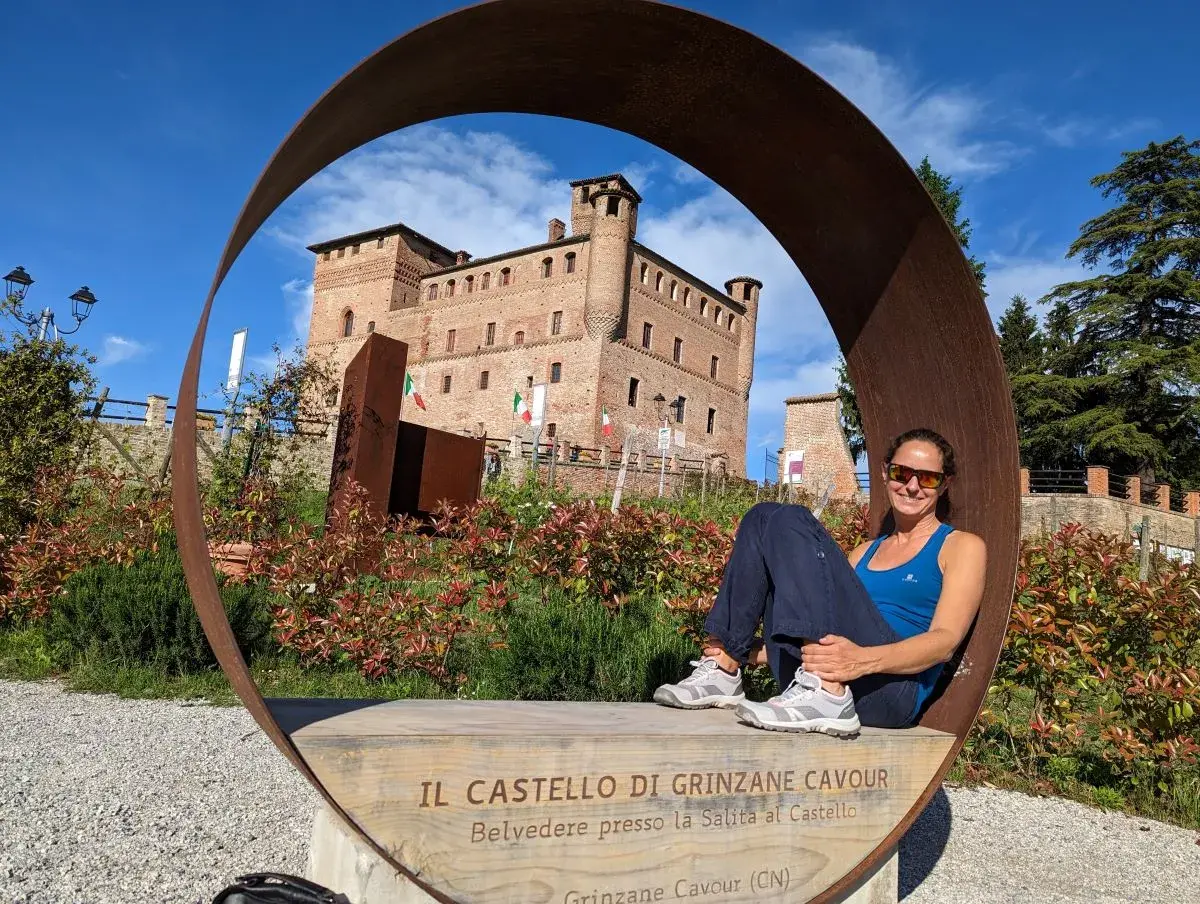
For me, Grinzane Cavour Castle is an absolute classic. Just a short drive from Alba, it rises from the vineyards with bold, almost fairy-tale architecture that makes it a real standout.
What I personally love most is the spacious castle courtyard, which wraps all the way around the building and offers a 360-degree panoramic view of the surrounding wine country.
Inside, you’ll find a small museum that includes personal items belonging to Camillo Benso, Count of Cavour, who was not only Italy’s first prime minister but also a passionate winemaker.
The attached Enoteca Cavour Piemontese is ideal for tasting your way through regional wines. I always recommend stopping here if you’re into Barolo or Barbaresco.
Distance from Alba: 10km / 15min by car
Opening times: Daily, except Tuesdays, from 10:00 – 19:00hrs
Ticket price: € 7.00 per person / free for owners of the Torino Piemonte Card
⇨ More info on the Turin city pass and if it is worth buying
Castello Roero – Monticello d’Alba
This castle is a little less well-known and that’s exactly what makes it so appealing to me. Castello Roero is located in Monticello d’Alba, a small village that’s easy to miss if you’re not looking for it.
Access to the interior is only possible as part of a guided tour, but the castle grounds are open to the public and they come with a modern twist: at various points in the park, you’ll find QR codes that link to short videos with fascinating background information, some of them even narrated by the count himself.
I think this adds a really unique touch to the whole experience.
Distance from Alba: 11km / 18min by car
Opening times: Only on weekends from 10:00 – 12:30hrs and 14:30 – 18:00hrs
Ticket price: € 7.50 per person
⇨ Further information on the Castello Roero

How to get to Alba and where to park
By plane: The closest international airports are those of Turin, Milan, and Genoa. From there, you can rent a car and drive to Alba in less than 2hrs.
By train: Alba is easily reached by train. From Turin, it will take you about 2 hours, a little more from Milan, and close to 3 hours of travel from Genoa.
By car: Alba and the surrounding wine region is a great day trip from Turin. The 62km drive via the Highway A6 (toll road) will take you about one hour.
Parking in Alba: Alba is easily accessible by car from all directions. The city also offers many parking spaces, most of which are paid. There is a free parking lot (⇨ location) near the historic center at the western entrance to the city, on Via Vivaro.
But beware: in the front parking area the spaces are paid (blue marking) and only the rear area (white marking) is free of charge.

What’s next?
Now that you know what Alba has to offer, it’s time to explore the surrounding wine region a bit more closely.
3-Day Itinerary for Wine Lovers
(Langhe, Roero and Monferrato)