

Acqui Terme Things to see
All you need to know about the historical spa paradise and hidden gem in southern Piedmont
I was really surprised by all the sights that I discovered in Acqui Terme during my 2-day visit. For a small town, this picturesque spot tucked away in the wine hills has an incredible amount of things to do and see.
When it comes to Acqui Terme things to see, the options are truly impressive!
Acqui Terme is famous for its ancient thermal springs. For centuries, these have attracted people seeking healing and relaxation.
But this small Piedmontese town, located just an hour’s drive from the Ligurian Mediterranean coast, is not just a place for wellness enthusiasts.
The town is also home to rich historical sites that reflect its interesting past. From impressive Roman ruins to medieval architecture, there really is a lot to discover here.
Lovers of Piedmontese specialties will not go amiss here either. The wine produced in the surrounding vineyards of Monferrato can be tasted everywhere in the lovely alleys of the historic center.
Read on to find everything you need to know for your stay in Acqui Terme, the spa center of Piedmont.
Acqui Terme Overview
The small town of Acqui Terme has almost 20000 inhabitants and is located in the southeast of Piedmont, in the Alexandria region.
The wellness center of Piedmont is set on the northern bank of the Bormida River, less than 1.5 hours from each of the major cities of Turin, Genoa and Milan.
Acqui Terme is surrounded by breathtaking wine landscapes, declared a World Heritage Site by UNESCO in 2014. Here are grown 9 DOC wines of the denomination Monferrato and 3 DOCG such as Barbera d’Asti.
Already the Romans were so enthusiastic about the existing healing springs that in 173 BC they destroyed the place, inhabited by a Ligurian tribe, and rebuilt it under the name of Aquae Statiellae.
Until the end of the Roman Empire, these thermal springs were among the best and most famous in the entire Imperium. The bishopric, founded in the 4th century, still exists today.
Acqui Terme had its heyday in the late Middle Ages. Many of the sights date back to this period.
Apart from the countless wellness offers and the historical highlights, the attractive town is also an excellent starting point for excursions, e-bike tours and hikes in the picturesque hilly landscape of the surrounding area.
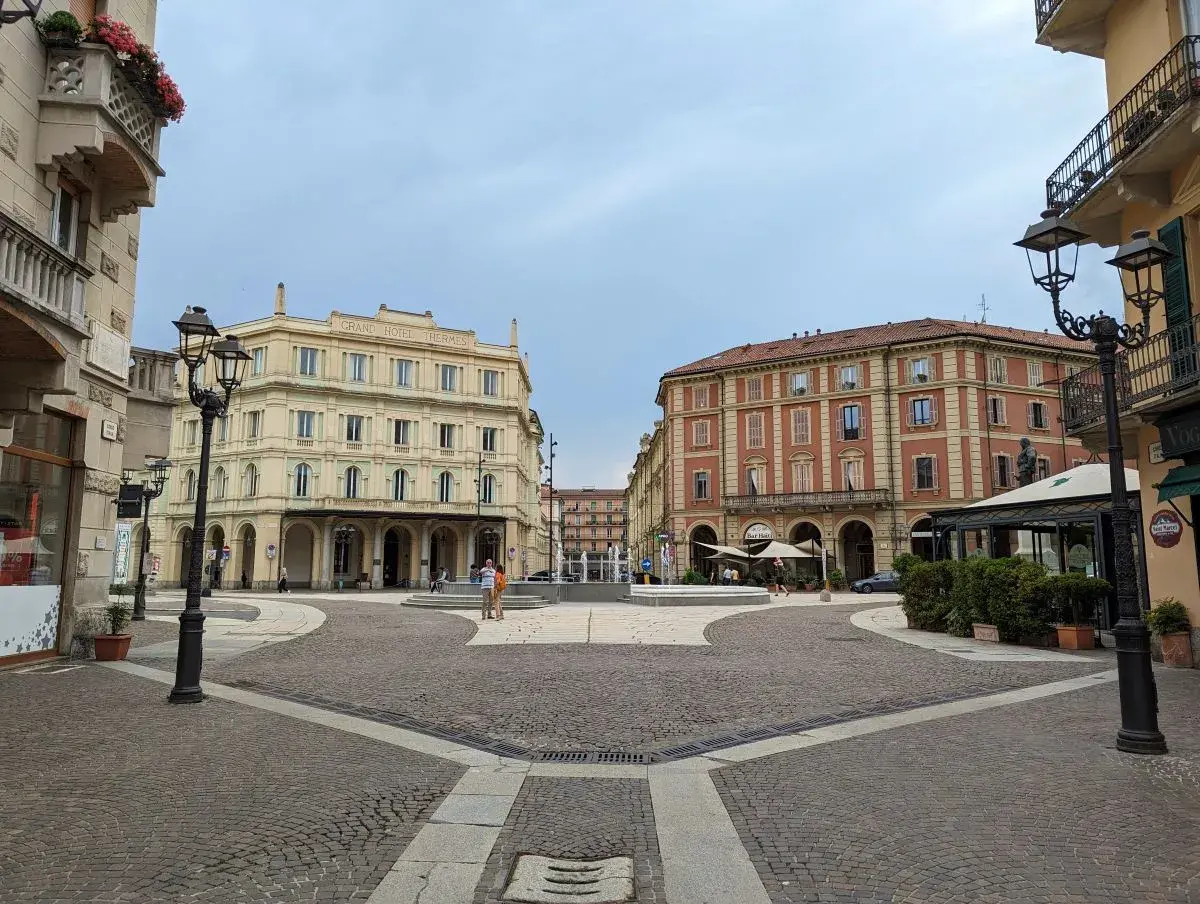
Acqui Terme Things to see
My Tip: Start your sightseeing tour of Acqui Terme with a visit to the tourist information office in Palazzo Comunale (⇨ location). Here you can get not only a map, but also a lot of information in English and other languages.
Pizza Bollente
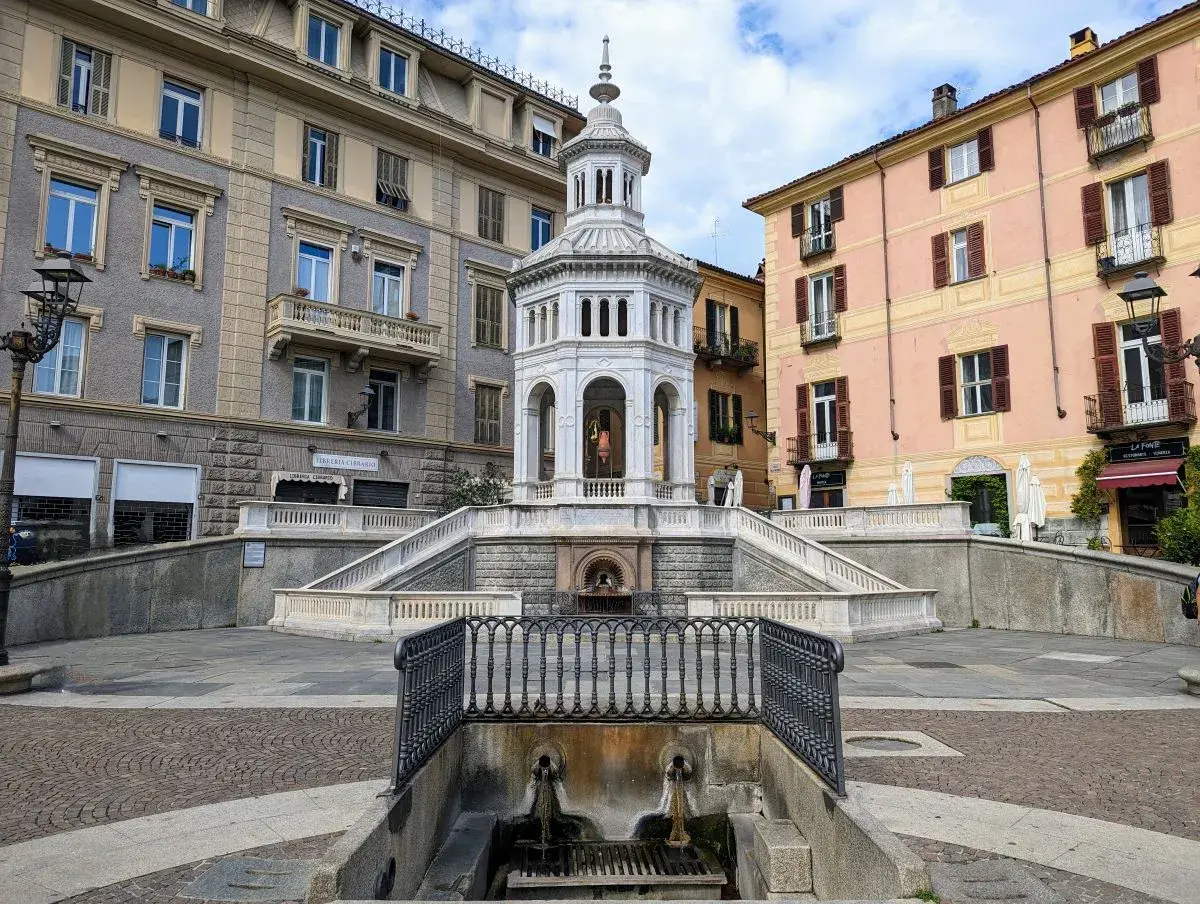
In the historic center, Piazza Bollente is probably the main attraction of the Acqui Terme Things to see.
Here stands the small Greek fountain-temple, Fontana della Bollente, built in 1879. From it gushes the 74.5 degrees hot sulfurous water.
In addition to sulfur, it also contains iodine, salt and bromine: healing for the respiratory tract and blood circulation.
Interesting (and brutal): According to legend, the newborn babies of the city were held with their heads briefly under the hot water. The survivors were called “sgaiento” (scalded).
The thermal healing water is still used today in the spa facilities of the city. It’s interesting to watch people come here and hold their noses in the healthy, rotten-egg-smelling steam. Of course, I did that too!
Also sight in Piazza Bollente is the city tower, the Torre Civica dell’Orologio, through which you enter the square from the main shopping street, Corso Italiana.
Cathedrale Santa Maria Assunta
From the outside, the cathedral seems almost inconspicuous, but from the inside it is incredibly impressive.
The bishopric of Acqui Terme already existed since the 4th century, but the construction of the cathedral began in 989. It was consecrated in 1067.
Particularly beautiful in the 5-nave cathedral are the white marble pulpit, the crypt with its countless columns and the picturesque cloister. The most important work of art is the three-part mural of the Madonna di Montserrat.
By the way, at several stations inside the cathedral there are interesting explanatory panels and in several languages!
Opening times: Daily from 8 am – 12 pm & 3 pm – 6 pm


Castle of Paleologi
The Castello Dei Paleologi towers above the picturesque old town alleys. The castle was probably built in the 11th century as the residence of the bishops and counts of Acqui.
Later it became a fortress as well as the seat of governors and marquises, until it was converted into a prison under Savoyard rule from the early 19th century.
Today, the archaeological museum is located within the fortress walls. Six rooms provide information about the exciting and varied history of the Acqui Terme area, from early times, through the Roman presence and the Middle Ages, to modern times.
Opening times: check their Homepage, as they vary
Ticket: € 4.00 per person
The Castelle Dei Paleologi is surrounded by a small botanical garden, from which I enjoyed a beautiful view over the old town rooftops.
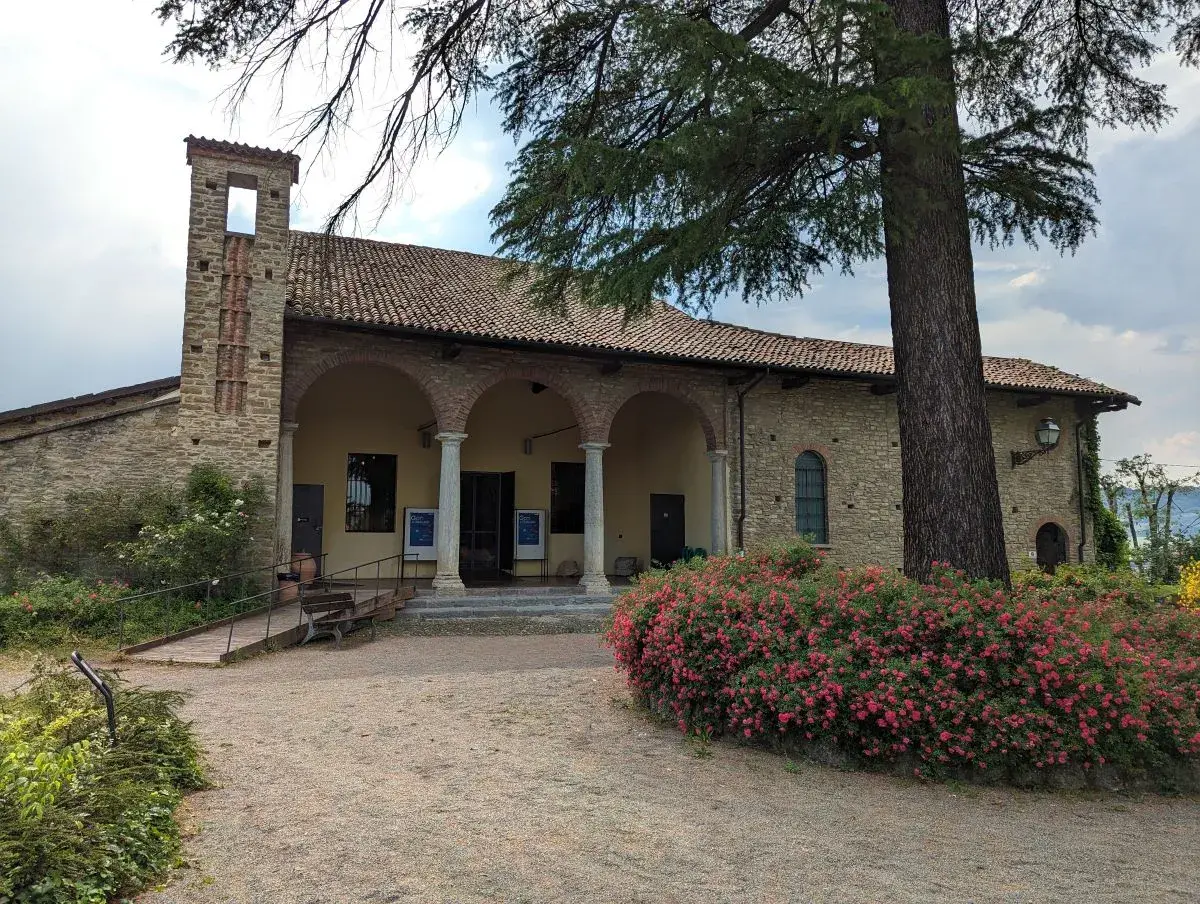
Acqui Terme old town
It’s best to let yourself wander through the beautiful streets of the cities historic center. Everywhere you will find small inviting taverns, wine cellars and “Enoteca – wine stores”, which will make you want to stay and enjoy the regional and Piedmontese specialties.
My Tip: The Enoteca Regionale Acqui “Terme e Vino” (⇨ Location) is slightly hidden in a vaulted cellar of a beautiful 16th century palazzi. It does not only sell local wines and offer tastings, but also provides information about Piedmontese wine products.
More Highlights of the Acqui Terme historic center:
Fontana delle Ninfee
The water lily fountain is one of the landmarks of the town of Acqui Terme. The long, white fountain stretches up the street over several basins.
At the starting point, Piazza Italia, there is also the beautiful Grand Hotel Nuove Terme, built in 1890, one of the largest and oldest health and wellness centers in the city.
Teatro Romano
Hidden among the houses of the old town, not far from Piazza Bollente, you can find the remains of a Roman theater. These were discovered only at the end of the 1990s.


Piscina Romana
Only in 1913 the 13m x 6.5m Roman basin was discovered at Corso Bagni. It is an important part of a huge thermal complex from the Roman Imperial period.
Opening times: check Homepage
Ticket: € 2.00 per person
More churches and monasteries
Worth visiting is the 15th century monastery church of San Francesco, Parrocchia di S. Francesco, at the northern entrance to the city center (⇨ Location).
The 11th-century Basilica dell’Addolorata is a beautiful stone church from the outside, unfortunately not (anymore) so opulently decorated from the inside (⇨ Location).
When you’re standing in Piazza del Duomo, you should look at the picturesque courtyard of the seminary palace, Seminario Maggiore, which now accommodates the Hotel La Meridiana.
Past the Duomo on the left, Via Barone once was home to the Monastery of Santa Caterina, also Seminaries Minore. Today you can dine in the historic ambience, on the loggia on the second floor in the restaurant Il Moncalvo (⇨ location).

Roman aqueduct
South of the city center, after crossing the river Bormida, via the Carlo Alberto bridge, on the right you can see the remains of the Roman aqueduct. It is one of the best preserved in the whole of northern Italy.
The route of the aqueduct, dating back to the first century, extends for a total length of about 12 km. It begins at the water collection basin in Lagoscuro, in the municipality of Cartosio, and runs, mostly underground, through the Erro Valley.
In the past there were probably forty pylons, the remains of which can be seen here in 2 fields on the river bank.
Along the Bormida, by the way, there is a wide footpath and bicycle path, which is a good starting point for hikes and bike tours in the surrounding vineyards.
My Hiking Tip: A scenic hike, along a panoramic path, leads from the aqueduct to the medieval village of Cavatore. Return either via the villages of Ovrano and Lussito (nr. 537 – 7km) or via the broom path (nr. 531 & 531a – 9km).
⇨ Tour info and photos via Komoot and in the Tourist Information Office.

Bagni district
South of the city center, on the southern side of the Bormida River, the Bagni district, or Antiche Terme, begins at the Roman aqueduct.
At the Fontefredda temple, there is another public source of sulfurous medicinal water. This one, however, has only 19 degrees. Because of the particularly intense “smell” it is also called Fontana Marcia (Lazy Spring). ⇨ (location).
On the Viale Antiche Terme you will find the municipal outdoor swimming pool. With its two large pools was the largest outdoor pool in Europe until the 1930s.

How to get to Acqui Terme and where to park
Acqui Terme is really conveniently located: the major cities of Turin, Milan and Genoa are each about 1.5h away by car. The regional capital Alessandria is 30km north, the cities of Asti and Alba are both 50km apart.
Only regional trains with destination Alessandria stop at the train station. A good parking lot, free of charge and close to the city center, is the Parcheggio Facelli (⇨ location).
Where to stay in Acqui Terme
Not only Acqui Terme itself but also the beautiful surroundings are worth a visit. Therefore, you should stay a few days in the region and choose Acqui Terme as a starting point for your excursions.
Accordingly, you will find a variety of accommodations in the city, in any price range.
Right in the center of town you’ll find the award-winning, family-run 3-star Hotel Acqui & Centro Benessere, with a small wellness center, sun terrace on the top floor, free parking, and bicycles for exploring the area.
For campers there is a Soster Camper Area directly on the river, not far from the Roman aqueduct, at € 10.00 per night (⇨ location).


